How to Store Bulky Winter Coats in a Studio Apartment (No Closet Needed)

Can You Store Winter Coats Without a Closet? The Short Answer
Yes — a studio apartment can hold a full winter coat rotation without a single built-in closet, as long as you split “daily-wear” coats from “off-season” coats and store each differently. Coats you grab every morning belong on a wall hook, door rack, or garment rack where they stay wrinkle-free and within reach. Coats you only wear a few times a season (a backup parka, a dress coat) can be compressed and tucked under the bed, in an ottoman, or on a closet shelf alternative without hurting their shape, as long as you follow a few prepping rules below.
The rest of this guide measures each option against your actual square footage — wall inches, door thickness, and under-bed clearance — so you’re matching the method to your apartment, not guessing. A couple of the inch figures below (like how much wall width a single hook needs) are editorial estimates based on typical coat dimensions rather than a cited spec sheet; we flag that distinction once here so we don’t have to repeat it in every section.
How Much Space Does a Winter Coat Actually Need? (Sizing Basics)
Before picking a method, it helps to know the real footprint of a coat:
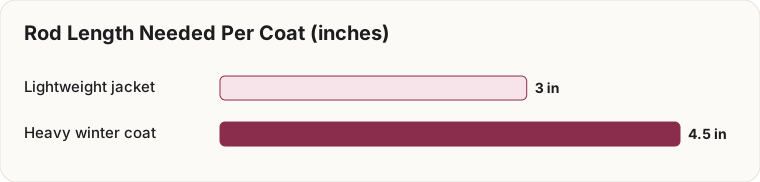
- Rod/hanging width: Plan on 3.5–4.5 inches of rod length per heavy winter coat — more than the 2–3 inches a lightweight jacket needs — because puffer and wool coats are bulkier on the hanger (closetbuiltins.com).
- Hanging height: A full-length coat needs a rod roughly 66–70 inches off the floor so the hem doesn’t drag or bunch (closetbuiltins.com).
- Depth when hung: Bulky coats can measure 22–24 inches cuff to cuff; closets or racks under 24 inches deep tend to pinch sleeves in doors.
- Compressed volume: A vacuum-sealed coat shrinks by roughly 70% of its original volume, which is the number that makes under-bed and ottoman storage realistic for puffers (packmate.co.uk).
Keep those four numbers in mind — they’re the yardstick for every option below.
Option 1: Wall Hooks and Coat Racks (Best for Daily-Wear Coats)
A row of wall hooks is still the fastest way to grab a coat on the way out the door, and it needs almost no floor space. Single hooks typically need only 6–8 inches of wall width each to hang a coat loosely by its collar loop or hanger hook (an editorial estimate, not a manufacturer spec, since hook spacing varies by brand).
The catch is weight. If you’re drilling into drywall over a hollow interior door or a non-stud wall, the door panel itself — not the anchor — is usually the limiting factor: anchors alone can rate up to 100 lbs, but a hollow-core door’s thin core “can vary in the weight it’ll tolerate,” which is why guidance generally lands on using such doors for light racks only, not a fully loaded coat run (housedigest.com). For anything heavier than a couple of coats, anchor into a stud whenever one is available rather than relying on hollow drywall alone.
Good for: 2–5 coats you wear weekly. Not ideal for: renters who can’t patch drilled holes before move-out — in that case, skip to Option 2.
Option 2: Over-the-Door Coat Racks (No Drilling Required)
If drilling isn’t an option, over-the-door hangers do the same job by looping over the top edge of any standard interior door, which is manufactured at 1-3/8 inches thick whether it’s hollow- or solid-core (vk-hardware.ca). That means almost every over-door product fits a studio’s interior doors without measuring first.
A few that are built specifically for coats rather than shoes or pantry items:
| Product | Width/Height | Door fit | Capacity | Price |
|---|---|---|---|---|
| IKEA ENUDDEN | 13¾" W x 5⅛" H | up to 1½" thick | 6 hooks | $9.99 |
| IKEA BÄRFIS (adjustable) | extends 29½"–39⅜" wide, 39¼" tall | less than 1½" thick | 9 lb max per hook | $29.99 |
| IKEA TJUSIG | 23½" L x 1½" D x 3¼" H | up to 1⅝" thick | wall- or door-mount | $14.99 |
| IKEA SKOGSVIKEN (2-pack) | reversible ends | ¾" to 1⅝" thick | 2 hooks | $2.99 |
All four hang from the door’s top edge with no drilling. For a deeper breakdown of over-door hardware beyond coats — shoes, bags, cleaning supplies — see our guide to the best over-the-door organizers for renters, which covers the no-drilling angle in more depth.
Good for: renters who can’t drill; closets with limited wall space near the entry. Not ideal for: more than 3–4 bulky coats at once — the hooks are close together and coats will overlap.
Option 3: Under-Bed Storage Bins and Vacuum Bags (Best for Off-Season Storage)
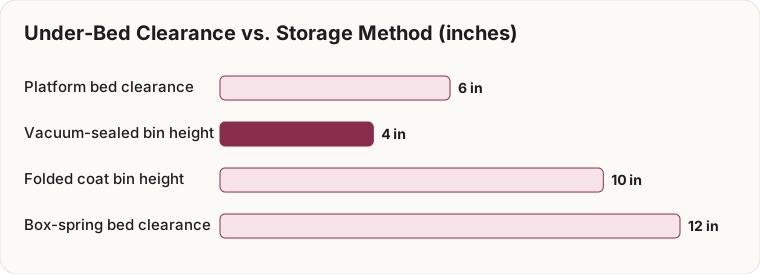
This is where compressed storage earns its keep. Clearance under a bed varies a lot by frame: platform beds can sit as low as 6 inches off the floor, while older box-spring setups often give 12 inches or more (storageworks.us). The rule of thumb from that same source is to subtract about an inch from your measured clearance to pick a bin height that won’t scrape the frame going in and out.
Folded (not vacuum-sealed) coats in a flat bin need roughly 6–10 inches of clearance depending on bulk, which already rules out the lowest platform beds. Vacuum-sealing closes that gap: because a compressed coat loses about 70% of its volume, a bin as shallow as 3–4 inches can often hold two or three flattened coats, fitting under even a 6-inch platform frame.
One caution: down-filled jackets keep their warmth from trapped air, so leaving them vacuum-packed indefinitely can flatten the fill over time. Treat vacuum bags as short-to-mid-season storage for down coats, and let them re-expand for a day before wearing again (packmate.co.uk).
If you’re already using under-bed space for other seasonal items, our guide on where to store Christmas decorations in a small apartment covers the same compressed, under-bed logic for ornaments and wrapping paper — useful if you’re trying to rotate holiday gear and winter coats through the same few cubic feet.
Good for: coats you only wear occasionally, or the full off-season stash from spring to fall. Not ideal for: coats you need within the next few weeks — pulling a vacuum bag out and re-fluffing a coat takes time you don’t want on a cold morning.
Option 4: Freestanding Garment Racks and Wardrobes
A rolling garment rack is the closest thing to an actual closet you can buy without construction. The VEVOR heavy-duty rolling rack, for example, measures 68.5" W x 17.7" D x 70.9" H, carries an 800 lb static overall capacity, and rates each hanging rod to 45 lb and each shelf to 90 lb, for $82.90 (vevor.com). At roughly 70 inches tall, it clears the 66–70 inch rod height recommended for full-length coats without the hems dragging.
The footprint — about 17.7 inches deep and 68.5 inches wide — is the real constraint in a studio. That’s close to the 26–28 inches of depth recommended for bulky coats in a built-in closet, so a garment rack against a wall, rather than floating in the middle of the room, is the more realistic placement.
Good for: anyone storing 8+ coats, or combining coat storage with a full wardrobe replacement. Not ideal for: studios under roughly 300 sq ft, where a 6-foot rack will dominate the room.
Option 5: Multi-Purpose Furniture (Storage Benches, Ottomans, Cube Organizers)
Storage ottomans double as seating, which matters when every square foot of a studio has to earn its place. The SONGMICS MAZIE ottoman, for instance, comes in 15" D x 30" W or 15" D x 43" W, both 15" H, with a 21-gallon (about 79.5-liter) interior, for $39.99 (songmics.com).
Twenty-one gallons sounds generous, but a single bulky folded parka can take up a third of that on its own — so an ottoman this size realistically holds one or two folded coats alongside blankets, not a full coat rotation. It’s best treated as overflow for the coat you wear least, not primary storage.
Good for: one backup coat plus blankets or linens, with seating as a bonus. Not ideal for: a household’s full coat collection — the interior volume fills up fast.
Comparison Table: Which Coat Storage Method Fits Your Space
| Method | Space needed | Best for | Drilling? | Approx. cost |
|---|---|---|---|---|
| Wall hooks | ~6–8 in of wall width per coat | Daily-wear coats | Usually yes | $3–$15 |
| Over-door rack | Door width (fits doors ¾"–2" thick) | Daily-wear coats, renters | No | $3–$30 |
| Under-bed bin (folded) | 6–10 in bed clearance | Off-season storage | No | $10–$30 |
| Vacuum bag under bed | 3–4 in bed clearance (compressed) | Off-season, low platform beds | No | $10–$25 for a multi-pack |
| Freestanding garment rack | ~18 in deep x 5–6 ft wide footprint | 8+ coats, full wardrobe swap | No | $80–$150 |
| Storage ottoman | 15 in H interior, 21–35 gal | 1–2 backup coats + seating | No | $40–$60 |
Step-by-Step: Prepping a Coat for Compressed or Under-Bed Storage
- Clean first. Launder or dry-clean the coat before storing — body oils and salt residue attract moths and set stains over months of storage.
- Dry completely. Any residual dampness in a sealed bag or bin encourages mildew.
- Fold along natural seams, not sharp new creases, to avoid permanent crush lines in down or wool.
- Choose the bag size to match your clearance. For a vacuum bag, pick one sized so the sealed coat’s thickness stays under your measured under-bed clearance minus about an inch.
- Seal and compress gradually, not in one hard push, especially for down — gradual compression is gentler on the fill.
- Label the bin or bag with the coat type and the month you packed it, so you’re not unsealing three bags to find one coat in November.
- Re-fluff down coats periodically if storing more than a season, letting them fully expand for a day before resealing.
Mistakes That Damage Coats in Small-Space Storage
- Compressing down coats for months at a time. The trapped-air structure that keeps down warm can flatten under sustained pressure; treat vacuum storage as short-to-mid-term for down, not year-round.
- Overloading a single over-door hook rack. Products like the IKEA BÄRFIS cap each hook at 9 lb — stacking a heavy wool coat and a scarf on one hook exceeds that fast.
- Hanging coats on wire hangers for months. Wire can stretch shoulders out of shape; a sturdier hanger protects the coat’s structure far better during storage, not just daily use.
- Choosing a bin taller than your actual clearance. Measure the lowest point of the bed frame — not the mattress — before buying bins; a half-inch miscalculation means the bin won’t slide in at all.
- Skipping the stud when drilling wall hooks. Hollow-core doors and drywall vary in how much weight they’ll tolerate — anchors alone can be rated up to 100 lbs, but the thin door or wall panel itself is usually the weak point — so a loaded run of coats is safer on a stud or over a door’s top edge than on bare hollow-core drywall.
FAQ: Storing Winter Coats in a Small Apartment
Do vacuum bags ruin down coats? Not if used short-term. Vacuum sealing can compress a coat by about 70% of its volume, which is great for space but can flatten down fill if left compressed for many months straight. Re-fluff the coat periodically and treat vacuum storage as a season-to-season solution rather than permanent.
Will an over-the-door rack fit my apartment’s doors? Almost certainly — standard interior doors are manufactured at 1-3/8 inches thick, and most over-door hangers (including the IKEA options compared above) are built for doors between ¾ inch and 2 inches, so a studio’s interior doors are well within range.
How many coats can I actually fit under a platform bed? It depends entirely on clearance. A 6-inch platform bed can usually only fit vacuum-sealed, flattened coats; a 10–12 inch frame can fit folded coats in shallow bins without compression.
Is it better to hang or fold a winter coat in storage? Hanging keeps shape best for structured wool coats worn regularly. Folding (often combined with vacuum sealing) is fine for puffer jackets stored off-season, since their quilted construction resists crease damage better than tailored wool.
What if I don’t want to drill any holes at all? Over-door racks, freestanding garment racks, and under-bed bins all avoid drilling entirely — between those three, most studio apartments can store a full coat rotation without putting a single hole in the wall.