Where to Store Board Games and Puzzles in a Small Living Room
Quick answer: the 5 best spots for board games in a small living room
For most small living rooms, the five storage spots that work best — in order of how little floor space they cost — are: a lidded storage ottoman doubling as a coffee table or extra seat, a closed media console shelf, a stack of flat under-couch bins, a wall-mounted shelf above eye level, and a freestanding cube shelving unit used as a low room divider. Which one is right for you depends less on taste and more on two numbers: how many games you own, and how deep your furniture piece actually is compared to your box depth. Get the depth match wrong and boxes either gap sideways on the shelf (they slide and topple) or hang over the edge (lids pop, corners crush).
We’ll walk through sizing first, then group solutions by collection size, because a 6-game starter set and a 35-game backlog need genuinely different furniture — not just “more of the same shelf.”
How much space do your games actually need?
Before buying anything, measure two things: box depth (the short dimension, how deep the box is front-to-back when lying flat) and total stack height (depth added up if you plan to lay boxes flat and stack them).
As a rough, editorial rule of thumb for sizing shelves — not a manufacturer spec, since box depth varies by publisher — classic family games (Monopoly-style, thin lid-and-base boxes) tend to run shallow, mid-weight strategy and Euro games (the kind with molded plastic inserts) run noticeably deeper, and “deluxe” or collector’s editions with extra components can be deeper still. The practical takeaway: don’t buy a shelf by eyeballing it. Pull out your three or four thickest boxes, measure the deepest one, and add half an inch of slack so boxes don’t jam.
Puzzles are easier to size: most boxed jigsaw puzzles are shallow and nearly square, so they stack well in a short, wide bin rather than standing upright on a narrow shelf, where they tend to lean and slump.
One more number worth knowing before you shop: a standard IKEA KALLAX cube shelf is 15 3/8 in deep, and a standard IKEA LACK wall shelf is 10 1/4 in deep — both confirmed on IKEA’s own product pages (KALLAX, LACK). That’s useful because most games will sit flat and shallow in a KALLAX cube with inches to spare, but a narrower 10 in-deep wall shelf like LACK is tight for anything but thin boxes standing on their spine.
Small collection (under 10 games): ottomans, coffee table storage, media console shelves
If you own fewer than ten boxes, you don’t need dedicated shelving at all — you need furniture that already does two jobs.
- Storage ottomans. A lidded ottoman that also serves as a coffee table or footrest hides the whole collection from view. The SONGMICS MAZIE storage ottoman, for example, comes in a 15 in deep by 30 in or 43 in wide version, both 15 in tall, with a 21-gallon interior — enough depth and volume for a small stack of games plus a blanket, confirmed on the manufacturer’s spec page (SONGMICS).
- Coffee tables with a lift-top or lower shelf. A coffee table with an open lower shelf keeps games within arm’s reach during game night without adding a separate piece of furniture to the room.
- Media console shelving. If your TV console has open cubbies or a closed cabinet, that’s usually deep enough (most media consoles run 15–18 in deep) to slide games in standing up, spine-out, like books.
None of these require tools, drilling, or measuring beyond “does it fit in the opening,” which is why they’re the default answer for a starter collection.
Medium collection (10–25 games): closet shelving, under-couch bins, vertical bookcases
Once you’re past about ten boxes, a single ottoman or console shelf runs out of room, and you need something purpose-built.
- Closet shelving. A spare shelf in a coat or linen closet works well if you have one to spare — but in a studio, that shelf is also competing with luggage, coats, and holiday decorations, so measure what’s already claimed before assuming the closet is free. (We cover that competition for suitcases specifically in our guide to storing luggage in a small apartment with no closet, which is worth a read if your closet is already tight.)
- Under-couch bins. Flat, lidded bins slide under a sofa if there’s enough leg clearance — standard sofa legs run roughly 2 to 8 in off the floor, so measure your own couch’s clearance before buying a bin taller than that. A flat-lying bin like the IKEA SOCKERBIT storage box (19 3/4 in W x 30 1/4 in D x 7 1/2 in H, $24.99, confirmed on IKEA’s product page) is shallow enough to clear most couches with taller legs, but will not fit under a low platform-style sofa.
- Vertical bookcases. A narrow bookcase like the IKEA BILLY (31 1/2 in W x 11 in D x 79 1/2 in H, per IKEA’s spec page) holds games standing up, spine-out, the same way you’d shelve books — but at 11 in deep, it’s tight for anything thicker than a mid-weight strategy box, so check your deepest box against that 11 in number before committing.
Large collection (25+ games): wall-mounted shelving, stacking crates, repackaging into flat bins
A serious collection — 25, 30, or more titles — usually needs vertical wall space, because floor-standing furniture runs out of square footage fast in a small living room.
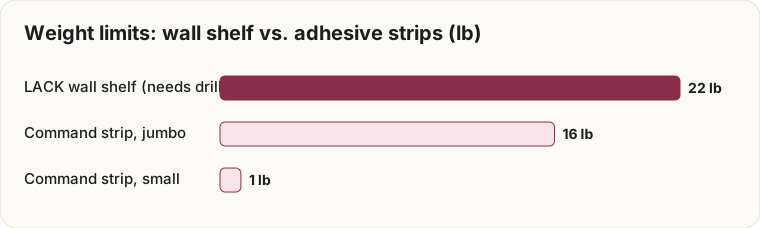
- Wall-mounted shelving. A shelf like the IKEA LACK (43 1/4 in L x 10 1/4 in D, $29.99, 22 lb max load per IKEA’s page) stores a row of games above furniture, using wall space the room isn’t otherwise using. Note the 22 lb limit: a dozen mid-weight board games can easily weigh more than that, so plan for multiple shelves or a sturdier bracket rather than one long single shelf loaded to capacity.
- Stacking cube shelving. A freestanding cube unit like the IKEA KALLAX (30 1/8 in square, 15 3/8 in deep, $49.99, 9 compartments, confirmed on IKEA’s page) can double as a low room divider between a living and dining area while holding two to three games flat per cube, depending on box size.
- Repackaging into flat bins. For a true 30+ game collection in a tight room, many collectors flatten boxes (keeping the lid art, discarding the bulky base) and repackage components into uniform flat bins or labeled zip-top bags. It’s more setup work, but it turns 30 irregularly-sized boxes into a handful of identically-sized, stackable containers — similar logic to how we recommend handling bulky seasonal items in our guide to storing Christmas decorations in a small apartment, where uniform bin sizing is what actually saves space, not a bigger shelf.
Renter-friendly, no-drill options for hanging or shelving games
If your lease doesn’t allow drilling, skip wall-mounted shelves like LACK — it’s rated for 22 lb but needs wall anchors or stud screws to hold that weight safely, which isn’t a renter-friendly install. Instead:
- Freestanding cube shelving (like KALLAX) needs zero wall attachment to function as a shelf; it only needs anchoring to the wall as a tip-over safety measure, which most manufacturers include as a strap, not a drilled bracket.
- Storage ottomans and under-couch bins involve no mounting at all.
- Command-style adhesive strips and hooks can hold small, light accessories — card holders, dice bags, a thin stacking tray — within their rated limits (small strips ~1 lb, up to jumbo sets rated 16 lb, per Command’s own weight guidance) but are not strong enough for a shelf loaded with multiple board games; use them for accessories, not for the games themselves.
- Over-the-door organizers are worth a look if you’re tight on floor space and have a coat closet or pantry door to spare — we cover specific no-drill models and their weight limits in our guide to the best over-the-door organizers for renters, several of which have pockets deep enough for card games and travel-size puzzles, if not full-size board games.
Keeping loose pieces and puzzles from getting mixed up
Board games lose playability fast once pieces migrate between boxes. Two habits fix most of it: bag components by game (small zip-top bags for tokens, dice, and cards, rubber-banded or taped shut inside the box) and store puzzles flat, not on edge, so gravity doesn’t shift loose pieces toward one corner over months of storage.
For puzzles specifically — especially if you like to work on one at a time without finishing it in a single sitting — stackable sorting trays solve the “half-done puzzle taking over the coffee table” problem. The Bits and Pieces Stack-Em trays, for example, are six trays measuring 7 3/4 x 5 3/4 in each, stacking to 4 1/4 in tall, rated for puzzles up to 750 pieces ($24.99, confirmed on the manufacturer’s page) — small enough to slide into the same ottoman or bin you’re already using for games.
Comparison table: storage method vs. space used vs. drilling required vs. best collection size
| Storage method | Approx. footprint | Drilling required? | Best collection size | Approx. cost |
|---|---|---|---|---|
| Storage ottoman | 15 x 30–43 in, doubles as furniture | No | Under 10 games | ~$40 |
| Media console shelf | Uses existing furniture | No | Under 10 games | $0 (if you own one) |
| Closet shelf | Uses existing closet space | No | 10–25 games | $0 (if space is free) |
| Under-couch bin | 19.75 x 30.25 x 7.5 in, slides under sofa | No | 10–25 games | ~$25 |
| Vertical bookcase (11 in deep) | 31.5 x 11 x 79.5 in floor footprint | Optional (anti-tip strap recommended) | 10–25 games | ~$100 |
| Wall-mounted shelf | 43.25 x 10.25 in, wall-mounted | Yes (stud/anchor) | 25+ games | ~$30/shelf |
| Cube shelving unit | 30 x 15.4 x 30 in floor footprint | No (freestanding) | 25+ games | ~$50 |
| Flattened/repackaged bins | Stacks to fit any shelf or closet | No | 25+ games | Varies |
FAQ
How do I store board games if I don’t have a closet? Lean on furniture that already has hidden storage — a lidded ottoman, a media console with doors, or under-couch bins sized to your sofa’s leg clearance. These options need no closet and no wall-mounting.
Can I store board games under a couch? Yes, if your sofa has enough leg clearance for a flat, lidded bin — most sofa legs run 2 to 8 in off the floor, so measure yours before buying a bin to fit.
What’s the best way to store board games in a studio apartment? Start with dual-purpose furniture (ottoman, console) for a small collection, then move to a freestanding cube shelf like KALLAX once you pass about ten games — it needs no wall drilling and can double as a room divider.
How do I keep puzzle pieces from getting mixed up with other puzzles? Store each puzzle flat (not standing on edge) in its own box or bag, and use stackable sorting trays if you like to work on one puzzle over several sessions without losing pieces to the coffee table.
Should board games be stored standing up or lying flat? Thin, book-like boxes do fine standing up, spine-out, on a shelf at least as deep as the box. Thicker boxes with loose components inside are more stable lying flat, since standing them up for long periods can let pieces shift and settle unevenly inside.